←Back to Dramas
Dramas from Studio CLICK TELEVISION COMPANY LIMITED
บริษัท คลิค เทเลวิชั่น จำกัด
About Studio
No description available.
Found 5 dramas

Sai Rom Kub Sam Lao
สายลมกับสามเรา
200613 eps
Channel:Channel 7 HD
Aired:September 20, 2006
Nana, a teenage girl who grew up in an orphanage, becomes entangled in a case of unintentional manslaughter. She is about to complete her probation and is preparing to report to Janejit.
Before leaving, Nana goes to say goodbye to Je Noi, the owner of a tattoo shop. On the way, Ongsa and Rongkla—heirs to a wealthy family that owns a sports club and water sports business—are traveling to scatter the ashes of their parents, who recently died in a sailing accident. They accidentally sideswipe Nana with their car but refuse to apologize; instead, they insult her by throwing money at her, which makes Nana furious.
Later, Nana meets France, a mischievous troublemaker at Je Noi’s shop. When he learns that Nana is heading to Bangkok, he offers to take her to the bus terminal. However, along the way, Nana discovers drugs hidden under the car. She tries to escape, but France catches on, leading to a fight between them.

99 Wan Chan Rak Ter
99 วันฉันรักเธอ
200514 eps
Channel:Channel 7 HD
Aired:August 6, 2005
Phetra (Priao) and Amarawadee (Or) are two talented creatives—one a copywriter, the other an account executive—working at The One, a rising advertising agency owned by Chartchai, a well-groomed former award-winning photographer.
Although the two women are highly skilled and often have to work closely together, they constantly clash over everything, both in their personal lives and at work, for reasons no one truly understands.
One day, Chartchai hires Pilan (Pun), a new photographer, to join the team. Priao immediately takes a dislike to him because she had encountered him before and mistakenly believed he was a pervert who secretly took obscene photos.
In contrast, Or warmly welcomes and speaks kindly to Pun right away. She, too, had met him before—but in her case, he had helped rescue her from a man who tried to take advantage of her by spiking her drink.

Langkha Daeng
หลังคาแดง
200412 eps
Channel:Channel 7 HD
Aired:April 28, 2004
This is the story of Thongdee, a young man who has failed in both his personal life and career. He works as a security guard at the entrance of a large company building. Unexpectedly, he is fired when the company installs a computerized system to control the building—automatic doors and CCTV—eliminating the need for many security guards. Thongdee becomes one of those laid off.
He tries to apply for new jobs, but no one hires him. Each day he goes out job hunting, only to return to his rented room, living in loneliness. His only companion is Mali, a stray dog he talks to and confides in. He often reminisces about his past with Namfon, his ex-girlfriend who left him. Still, he holds onto hope that one day he will succeed and win her back. That hope keeps him going, despite society seeing him as a failure.
Eventually, unable to find work and falling behind on rent, Thongdee is evicted. Frustrated, he blames his downfall on being fired. He believes he was an excellent employee—someone everyone in the company knew, from janitors to executives, because he greeted them daily with a smile. He refuses to believe a computer could replace him.
Determined to seek justice, Thongdee returns to the company and tries to meet the president, but is arrested for his bold actions. At the same time, a wealthy woman named Chomsri, living abroad, reports her missing husband, Koytong. The last evidence she has is a letter and a photo—showing Koytong after plastic surgery, now looking exactly like Thongdee.
Due to this resemblance, Thongdee is mistaken for Koytong while in police custody. Despite his protests, no one believes him. The police assume Koytong has gone insane due to stress and paranoia. Thongdee is sent to “Red Roof Hospital,” a psychiatric institution founded by Koytong himself.
Unaware of where he is, Thongdee is treated like the hospital’s owner and given special privileges. Staff are excited by his presence, as the real Koytong has always been mysterious and never appeared publicly. Meanwhile, the new hospital director arrives, and a welcome party is held. During the event, chaos erupts when lower-class patients crash the party. At that moment, Thongdee realizes he is in a mental hospital and faints.
When he wakes, he insists he is not Koytong, but this only convinces others that his condition is severe. The new director introduces a policy to create equality among patients, reducing privileges for elite patients—except for “Koytong.”
Thongdee struggles to escape, forming a bond with a patient named Alai, the only person he can communicate with. Alai suffers from emotional trauma after being abandoned by her lover and later by her family. Thongdee promises to help her escape and reunite with her family.
He devises an escape plan, manipulating other patients into helping him. After several failed attempts, he finally escapes alone, leaving the others behind to face punishment. Feeling betrayed, the patients lose trust in him—except Alai, who still believes in him.
Outside, Thongdee becomes homeless, realizing society views him no differently from the “mad” people he once looked down on. He is eventually caught and returned to the hospital.
Over time, guilt changes him. Seeing how his actions harmed others, he decides to take responsibility. He pretends to be Koytong, believing he can use the identity to improve the hospital and help the patients. Chomsri, thinking her husband has recovered, takes him back to the mansion.
Living as Koytong, Thongdee improves the hospital, bringing life and hope back to the patients. He grows close to Alai and eventually brings her to live with him. However, this sparks tension with Chomsri, who begins to suspect something is wrong.
As secrets unravel—affairs, hidden wealth, and identity confusion—Thongdee finds himself trapped in a dangerous web of lies. When he tries to escape with Alai, he is betrayed and captured again. He is subjected to electroshock therapy, leaving him seemingly emotionless and memoryless.
Alai is devastated but eventually realizes he never intended to betray her. Meanwhile, Thongdee secretly regains awareness and pretends to remain insane, planning to outsmart Chomsri and expose the truth.
As Chomsri manipulates the system to declare Koytong legally insane and seize his fortune, tensions rise. The hospital prepares for its anniversary celebration, where she plans to publicly reveal “Koytong’s madness.”
The stage is set for a dramatic confrontation—truth, identity, and justice are about to collide.

Supabaroot Luke Pu Chai
สุภาพบุรุษลูกผู้ชาย
200312 eps
Channel:Channel 7 HD
Aired:February 12, 2003
Rang (Porshe Saran Sirilak) is an orphaned young man whose only possession from his past is a violin-shaped locket. He works tirelessly at various jobs to support his education and to save money for an eye surgery for Koy, a blind girl he cares for like a younger sister. Despite living a humble life in a slum, he finds happiness with his sister and his close-knit group of friends, Bo, Tay, and Cheng.
Praewa (Bo Thanyasupang Jirapreechanon) is a beautiful, high-society woman. Rang secretly falls in love with her, though he is painfully aware of the vast social gap between them. Praewa already has a partner, Tawanchai.
Eventually, Praewa hires Rang to work as her assistant. Her father, Phaolap, wants to push Praewa to take over his position so he can enter politics under the party of Suriya (Tawanchai’s father). He faces a rival, Thepthorแสง, who also tries to use Suriya as a shortcut to secure government concessions.
As Praewa steps up to manage the business in place of Phaolap, her transition causes deep resentment in Orathai, Phaolap’s younger sister, who is dissatisfied with the arrangement.
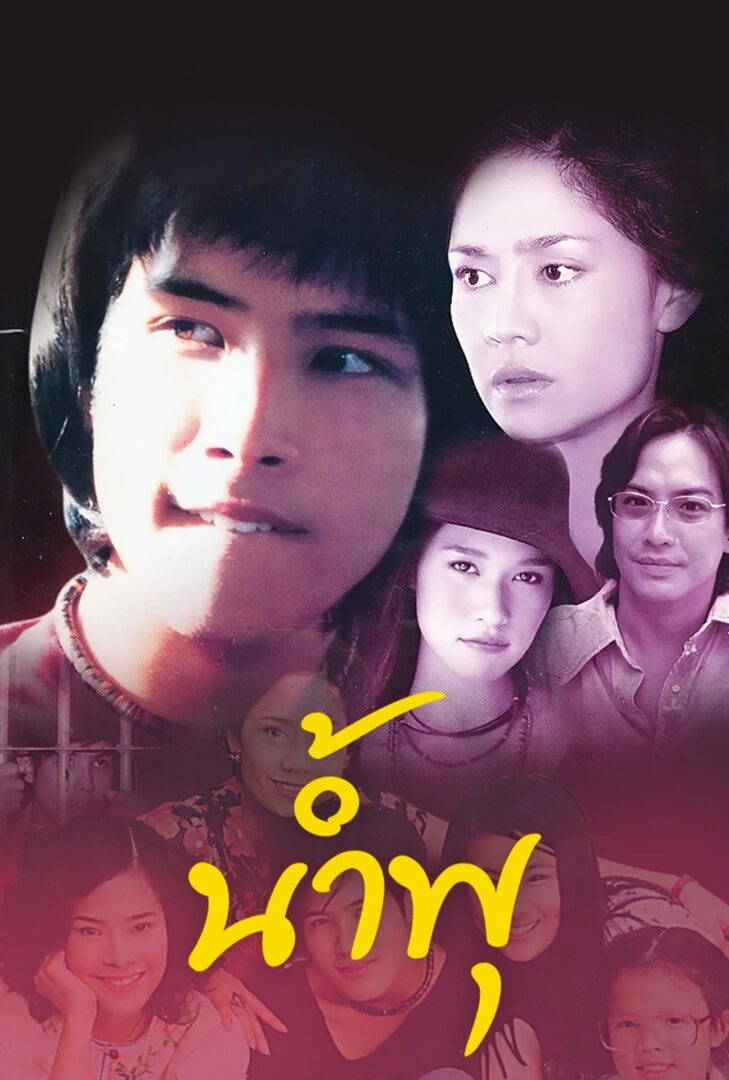
Nam Pu
น้ำพุ
200233 eps
Channel:Channel 7 HD
Aired:April 2, 2002
The story of Namphu is a poignant reflection on a child caught in the middle of a broken home. Both of his parents are artists, and as Namphu grows up, he begins to lose his way. The dissolution of his parents' relationship and his mother's decision to take a new husband act as catalysts, making him feel increasingly alienated from his own family.
The Downward Spiral
Seeking a sense of belonging he cannot find at home, Namphu falls in with a group of friends who use drugs. He eventually becomes heavily addicted to heroin. When his close friend, Kaew, discovers his addiction, Namphu is overcome with guilt and sorrow. This turning point leads him to confess the truth to his mother and family.
The Struggle for Redemption
Determined to change, Namphu and his friends travel to Wat Tham Krabok, a famous monastery known for its grueling detoxification program, to kick the habit. He successfully completes the treatment and returns home, hopeful for a fresh start and a warm reconciliation with his loved ones.
The Tragic End
However, upon his return, the reception from his family is not as supportive or welcoming as he had envisioned. Feeling neglected and misunderstood—a common vulnerability in teenagers—he falls into a deep state of despondency. In a momentary lapse of judgment fueled by hurt, he turns back to the drug one last time, administering a fatal overdose of heroin that ends his young life.